 Add to Chrome
 Add to Firefox
 Add to Edge
Learning to Adapt: Self-Improving Web Agent via Cognitive-Aware Exploration
May 29, 2026
Recent advances in Multimodal Large Language Models (MLLMs) have led to promising progress in web agents. However, existing web agents often rely on handcrafted execution pipelines or expensive expert trajectories, limiting their adaptability to complex, dynamic environments. To address these challenges, we propose SCALE (Self-Cognitive-Aware Learning and Exploration), which leverages three adversarial roles, Selector, Predictor, and Judger to autonomously discover the agent's limitations and expand its cognitive boundaries through environmental exploration. Moreover, we propose SCALE-Hop, a graph exploration strategy that facilitates global planning and helps agents avoid local exploration traps. To further support learning, we construct SCALE-20k, a large-scale dataset collected from 19 real-world websites, containing diverse task types and structured demonstrations generated from SCALE's exploration traces. Experimental results show that our approach significantly improves the performance and generalization of multiple MLLMs in various web environments. Our framework offers a scalable and generalizable solution for building truly autonomous and adaptive web agents.

VisualThink-VLA: Visual Intermediate Reasoning for Effective and Low-Latency Vision-Language-Action Policies
May 28, 2026Recent work has begun to equip vision-language-action (VLA) policies with explicit intermediate reasoning. In embodied control, however, textual chain-of-thought is a poor fit: irrelevant or weakly textual information can interfere with action prediction, while autoregressive text decoding adds too much latency for real-time closed-loop execution. We present VISUALTHINK-VLA, a visual intermediate-reasoning framework for accurate, low-latency VLA policies. Our bootstrapping philosophy is to guide action with effective visual thinking: VISUALTHINK-VLA bootstraps action prediction through a compact visual-evidence interface that preserves spatial precision while avoiding decoding overhead. Besides, to further improve performance and efficiency, VISUALTHINK-VLA adopts a tailored selective routing mechanism to learn the visual evidence tokens, enabling low-latency inference while preserving high-capacity specialization. We also introduce VisualEvidence-Kit, a supervision-and-audit resource centered on a VisualEvidence-Agent that constructs a 754.7k VLA instructions VisualEvidence-Set for route supervision and counterfactual faithfulness tests. Across multiple benchmarks and real-robot evaluation, VISUALTHINK-VLA achieves the highest success rate on most benchmarks while reducing the multi-second latency of reasoning-augmented baselines to the sub-second regime. For example, on BridgeData V2, it reduces step latency from 8.377,s with ECoT to 0.367,s, achieving a 22.8 times speedup.
InstructSAM: Segment Any Instance with Any Instructions
May 25, 2026In this paper, we introduce InstructSAM, a unified and streamlined framework designed for multi-instance segmentation under arbitrary instructions. We formulates instruction-driven instance segmentation as a set-structured query prediction problem and propose an explicit reasoning-to-instance query interface that elegantly bridges a vision-language model (VLM) and SAM3. Specifically, a bank of learnable instance queries is injected into the VLM and contextualized with instruction and visual information, enabling each query to serve as an instance-aware slot. A hybrid-attention mechanism further promotes interaction among these queries, visual tokens, and instruction tokens, improving instance enumeration and reducing duplicate predictions. The resulting LLM-conditioned queries are projected into SAM3's detector query space to drive accurate multi-instance segmentation in a single forward pass. This design equips SAM3 with high-level instruction understanding, compositional reasoning, and instance-level set prediction without modifying its core architecture. To support training and evaluation, we further construct Inst2Seg, a high-quality and large-scale instruction-based instance segmentation dataset and benchmark that couples free-form instructions with instance-level masks. Extensive experiments show that only 2B-scale InstructSAM achieves strong results across complex instruction-driven and phrase-level referring segmentation benchmarks, outperforming prior end-to-end methods and SAM3's agentic pipeline while enabling efficient single-pass multi-instance prediction.
CrossView Suite: Harnessing Cross-view Spatial Intelligence of MLLMs with Dataset, Model and Benchmark
May 18, 2026Spatial intelligence requires multimodal large language models (MLLMs) to move beyond single-view perception and reason consistently about objects, visibility, geometry, and interactions across multiple viewpoints. However, progress in cross-view reasoning remains limited by three major gaps: the scarcity of large-scale well-annotated training data, the lack of comprehensive benchmarks for systematic evaluation, and the absence of explicit alignment mechanisms that establish object-level consistency across views. To address these gaps, we thoroughly develop CrossView Suite across three coordinated components: CrossViewSet, CrossViewBench, and CrossViewer. Firstly, we introduce a multi-agent data engine to meticulously curate a large-scale, high-quality cross-view instruction dataset, termed CrossViewSet, covering 17 fine-grained task types with 1.6M samples. Second, we meticulously create a scene-disjoint CrossViewBench to comprehensively assess the cross-view spatial understanding capability of an MLLM, evaluating it across various aspects. Finally, we propose CrossViewer, a progressive three-stage framework for cross-view spatial reasoning in MLLMs, following a Perception -> Alignment -> Reasoning paradigm. Our method equips an adaptive spatial region tokenizer to capture fine-grained object representations, and then aligns the multi-view objects explicitly, and thus fuses aligned features for boosting the cross-view inference capacity for MLLMs. Extensive experiments and analyses show that large-scale training data, systematic evaluation, and explicit cross-view alignment are all critical for advancing MLLMs from single-view perception toward real-world spatial intelligence. The project page is available at https://github.com/Thinkirin/Crossview-Suite.
OmniWeaving: Towards Unified Video Generation with Free-form Composition and Reasoning
Mar 25, 2026While proprietary systems such as Seedance-2.0 have achieved remarkable success in omni-capable video generation, open-source alternatives significantly lag behind. Most academic models remain heavily fragmented, and the few existing efforts toward unified video generation still struggle to seamlessly integrate diverse tasks within a single framework. To bridge this gap, we propose OmniWeaving, an omni-level video generation model featuring powerful multimodal composition and reasoning-informed capabilities. By leveraging a massive-scale pretraining dataset that encompasses diverse compositional and reasoning-augmented scenarios, OmniWeaving learns to temporally bind interleaved text, multi-image, and video inputs while acting as an intelligent agent to infer complex user intentions for sophisticated video creation. Furthermore, we introduce IntelligentVBench, the first comprehensive benchmark designed to rigorously assess next-level intelligent unified video generation. Extensive experiments demonstrate that OmniWeaving achieves SoTA performance among open-source unified models. The codes and model will be made publicly available soon. Project Page: https://omniweaving.github.io.
Draft-Thinking: Learning Efficient Reasoning in Long Chain-of-Thought LLMs
Feb 28, 2026Long chain-of-thought~(CoT) has become a dominant paradigm for enhancing the reasoning capability of large reasoning models~(LRMs); however, the performance gains often come with a substantial increase in reasoning budget. Recent studies show that existing CoT paradigms tend to induce systematic overthinking, unnecessarily coupling reasoning capability with reasoning cost. Most prior approaches reduce token usage through post hoc techniques such as token compression, truncation, or length penalties, without explicitly addressing the core mechanisms of reasoning. We propose \textbf{Draft-Thinking}, which guides models to first learn a concise \textit{draft-style} reasoning structure that retains only the critical reasoning steps. Through a \textit{progressive curriculum learning}, the model stably internalizes this efficient reasoning pattern as its capability scales. Moreover, Draft-Thinking introduces adaptive prompting, which elevates reasoning depth to a flexible, model-selectable behavior. Extensive experiments demonstrate that Draft-Thinking substantially reduces reasoning budget while largely preserving reasoning performance; for example, on MATH500, it achieves an 82.6\% reduction in reasoning budget at the cost of only a 2.6\% performance drop.
CoMoL: Efficient Mixture of LoRA Experts via Dynamic Core Space Merging
Feb 28, 2026Large language models (LLMs) achieve remarkable performance on diverse downstream and domain-specific tasks via parameter-efficient fine-tuning (PEFT). However, existing PEFT methods, particularly MoE-LoRA architectures, suffer from limited parameter efficiency and coarse-grained adaptation due to the proliferation of LoRA experts and instance-level routing. To address these issues, we propose Core Space Mixture of LoRA (\textbf{CoMoL}), a novel MoE-LoRA framework that incorporates expert diversity, parameter efficiency, and fine-grained adaptation. Specifically, CoMoL introduces two key components: core space experts and core space routing. Core space experts store each expert in a compact core matrix, preserving diversity while controlling parameter growth. Core space routing dynamically selects and activates the appropriate core experts for each token, enabling fine-grained, input-adaptive routing. Activated core experts are then merged via a soft-merging strategy into a single core expert, which is combined with a shared LoRA to form a specialized LoRA module. Besides, the routing network is projected into the same low-rank space as the LoRA matrices, further reducing parameter overhead without compromising expressiveness. Extensive experiments demonstrate that CoMoL retains the adaptability of MoE-LoRA architectures while achieving parameter efficiency comparable to standard LoRA, consistently outperforming existing methods across multiple tasks.
CORE: Code-based Inverse Self-Training Framework with Graph Expansion for Virtual Agents
Jan 05, 2026The development of Multimodal Virtual Agents has made significant progress through the integration of Multimodal Large Language Models. However, mainstream training paradigms face key challenges: Behavior Cloning is simple and effective through imitation but suffers from low behavioral diversity, while Reinforcement Learning is capable of discovering novel strategies through exploration but heavily relies on manually designed reward functions. To address the conflict between these two methods, we present CORE, a Code-based Inverse Self-Training Framework with Graph Expansion that bridges imitation and exploration, offering a novel training framework that promotes behavioral diversity while eliminating the reliance on manually reward design. Specifically, we introduce Semantic Code Abstraction to automatically infers reward functions from expert demonstrations without manual design. The inferred reward function, referred to as the Label Function, is executable code that verifies one key step within a task. Building on this, we propose Strategy Graph Expansion to enhance in-domain behavioral diversity, which constructs a multi-path graph called Strategy Graph that captures diverse valid solutions beyond expert demonstrations. Furthermore, we introduce Trajectory-Guided Extrapolation, which enriches out-of-domain behavioral diversity by utilizing both successful and failed trajectories to expand the task space. Experiments on Web and Android platforms demonstrate that CORE significantly improves both overall performance and generalization, highlighting its potential as a robust and generalizable training paradigm for building powerful virtual agents.
OmniMoGen: Unifying Human Motion Generation via Learning from Interleaved Text-Motion Instructions
Dec 22, 2025Large language models (LLMs) have unified diverse linguistic tasks within a single framework, yet such unification remains unexplored in human motion generation. Existing methods are confined to isolated tasks, limiting flexibility for free-form and omni-objective generation. To address this, we propose OmniMoGen, a unified framework that enables versatile motion generation through interleaved text-motion instructions. Built upon a concise RVQ-VAE and transformer architecture, OmniMoGen supports end-to-end instruction-driven motion generation. We construct X2Mo, a large-scale dataset of over 137K interleaved text-motion instructions, and introduce AnyContext, a benchmark for evaluating interleaved motion generation. Experiments show that OmniMoGen achieves state-of-the-art performance on text-to-motion, motion editing, and AnyContext, exhibiting emerging capabilities such as compositional editing, self-reflective generation, and knowledge-informed generation. These results mark a step toward the next intelligent motion generation. Project Page: https://OmniMoGen.github.io/.
WEAVE: Unleashing and Benchmarking the In-context Interleaved Comprehension and Generation
Nov 14, 2025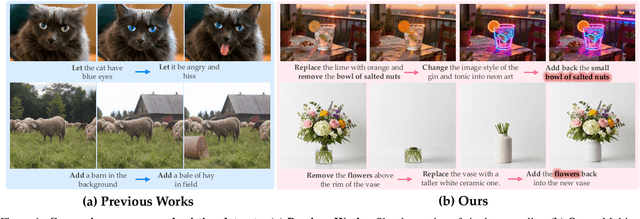
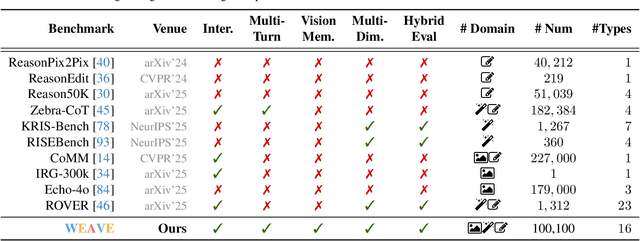
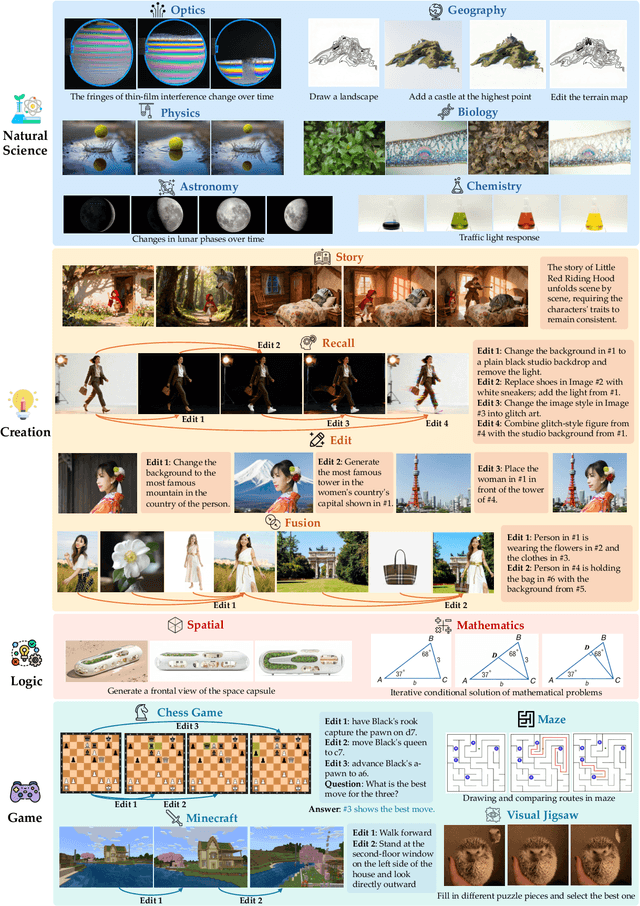
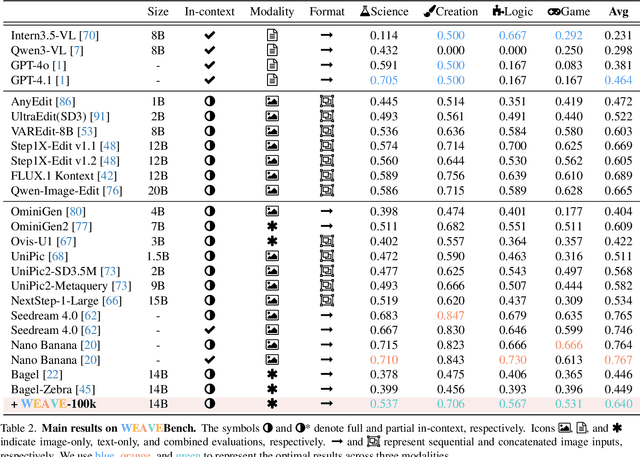
Recent advances in unified multimodal models (UMMs) have enabled impressive progress in visual comprehension and generation. However, existing datasets and benchmarks focus primarily on single-turn interactions, failing to capture the multi-turn, context-dependent nature of real-world image creation and editing. To address this gap, we present WEAVE, the first suite for in-context interleaved cross-modality comprehension and generation. Our suite consists of two complementary parts. WEAVE-100k is a large-scale dataset of 100K interleaved samples spanning over 370K dialogue turns and 500K images, covering comprehension, editing, and generation tasks that require reasoning over historical context. WEAVEBench is a human-annotated benchmark with 100 tasks based on 480 images, featuring a hybrid VLM judger evaluation framework based on both the reference image and the combination of the original image with editing instructions that assesses models' abilities in multi-turn generation, visual memory, and world-knowledge reasoning across diverse domains. Experiments demonstrate that training on WEAVE-100k enables vision comprehension, image editing, and comprehension-generation collaboration capabilities. Furthermore, it facilitates UMMs to develop emergent visual-memory capabilities, while extensive evaluations on WEAVEBench expose the persistent limitations and challenges of current approaches in multi-turn, context-aware image generation and editing. We believe WEAVE provides a view and foundation for studying in-context interleaved comprehension and generation for multi-modal community.